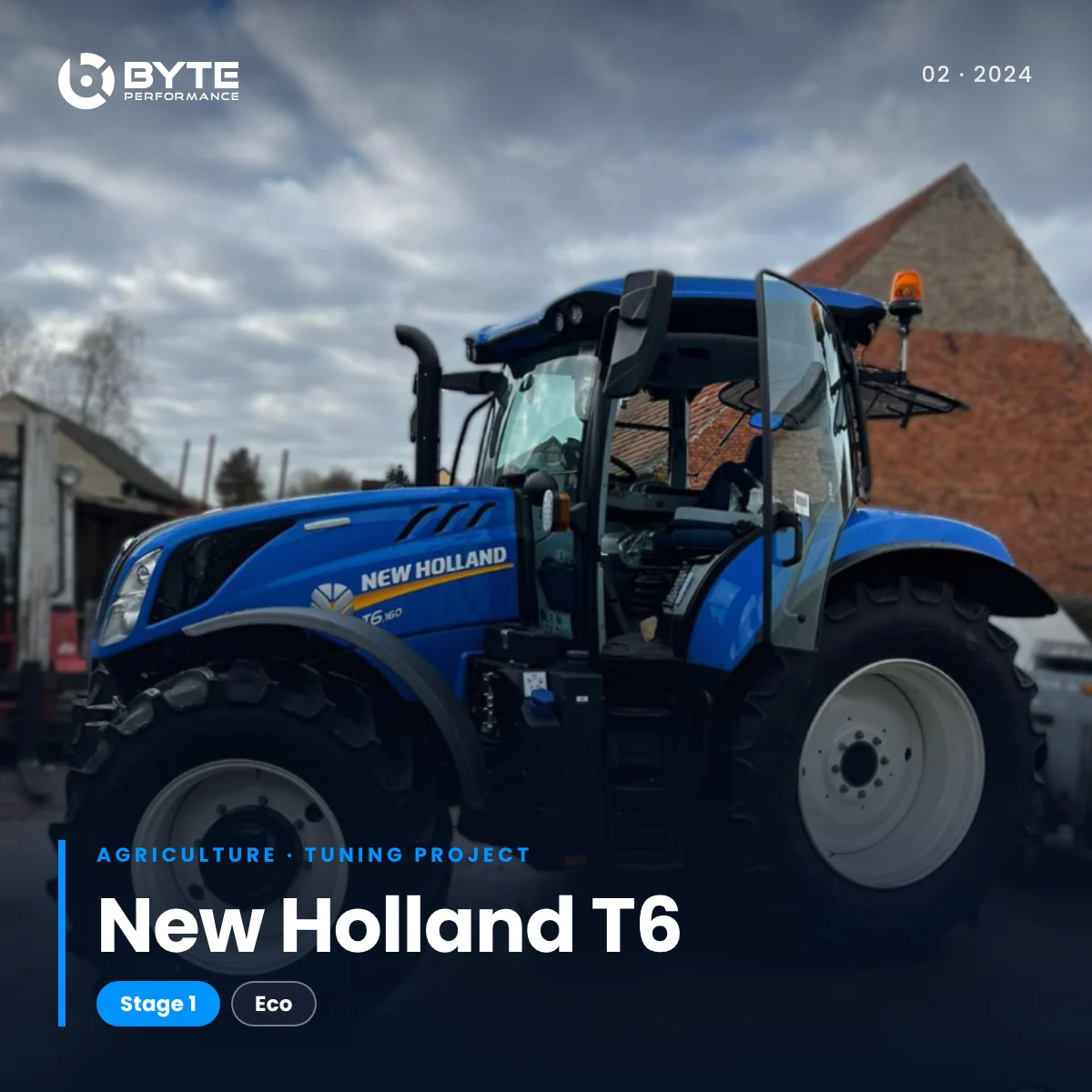
| Machine | New Holland T6 (standard tractor) |
|---|---|
| Solution | Stage 1 / Eco |
The situation
The T6 is a mid-range standard tractor that most farms use for everything from cultivating and drilling to loader work and transport. It is a well-balanced machine, but its stock calibration is a compromise across all the markets New Holland sells into. Farms that run heavy implements or pull loaded trailers on gradients feel the limit first, and at the same time fuel is one of their largest variable costs.
The farm wanted more pull for heavy work and lower fuel consumption over the season – a file built around efficiency rather than peak output.
What we did
The engine ECU was read and the file developed for this software version.
- Stage 1: injection quantity, rail pressure and boost adjusted within the limits of the stock hardware – more torque in the working range, so the tractor pulls heavier implements and loaded trailers without dropping rpm.
- Eco: injection timing and the torque curve calibrated for a more complete combustion and a higher gear at lower engine speed under load. That is where the fuel saving comes from – the same work with less fuel and, as a consequence, lower emissions per hectare.
Checksum corrected and the file written to the ECU.
The result
More tractive power, lower fuel consumption and a tractor that handles heavy implements with reserve instead of at its limit. For the farm this means faster work rates in the field and lower fuel cost per hectare on the same jobs. Files for the T6 are developed from the original read of each tractor, not from a generic base – the software version decides what the file looks like.
Need a file for this machine?
Byte Performance develops files individually for engine, ECU and software version. Dealers get access to the full database, dealer pricing and direct engineer support. Become a dealer or ask about a machine.
* Emission-related solutions (DPF, EGR, AdBlue/SCR) are intended for off-road, agricultural, export and motorsport use only, where permitted by local law. The operator is responsible for legal use in their market.