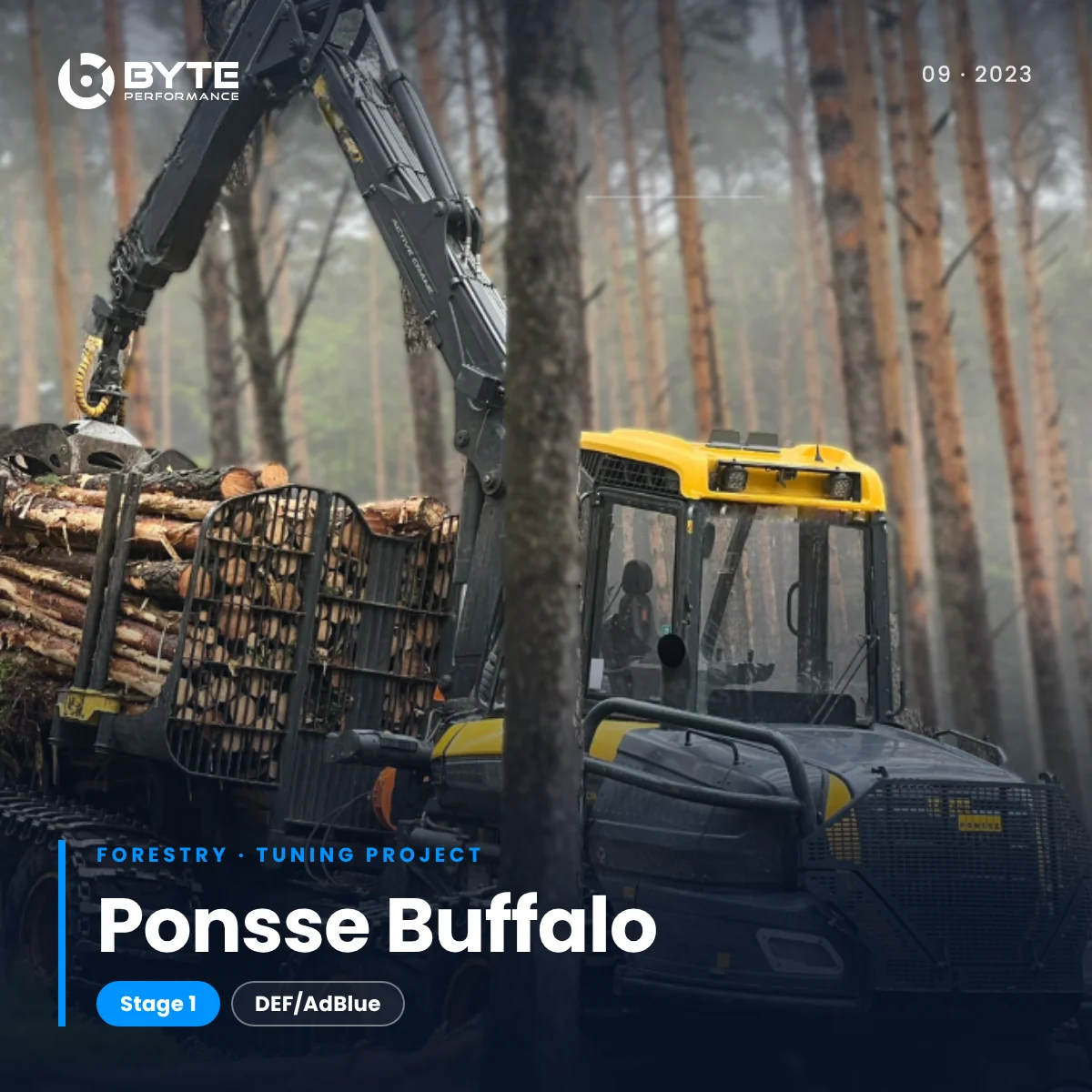
| Machine | Ponsse Buffalo (forwarder) |
|---|---|
| Engine | Mercedes diesel, 286 hp stock, 185 kN tractive force |
| Solution | Stage 1 (around +20 %) + AdBlue/SCR off* |
The situation
The Buffalo is a forwarder built for long days hauling timber over steep ground and soft terrain. With a 286 hp Mercedes engine and 185 kN of tractive force it is already a capable machine. In forestry, however, the limiting factor is often not the engine but the after-treatment: an AdBlue system that throws faults in the forest means a derated machine far from the next workshop, and every unplanned stop is lost production.
The operator wanted two things: more pull for full loads on steep extraction tracks, and an end to AdBlue-related downtime.
What we did
The engine ECU was read and the file developed for this software version.
- Stage 1: injection quantity, rail pressure and boost adjusted within the limits of the stock hardware – around 20 % more power with a torque curve that supports the hydrostatic drive at low rpm rather than peaking at the top.
- AdBlue/SCR: dosing and level monitoring deactivated in software, related DTCs and the derate strategy handled. The forwarder no longer depends on DEF supply or a working SCR system to keep running.
Checksum corrected and the file written to the ECU.
The result
Around 20 % more power, stronger pull with a full load on steep ground and no AdBlue warnings or derate. For the forestry contractor this means fewer stops, no repair costs on the AdBlue system and more hours a year in the forest. Files for the Buffalo are developed from the original read of each machine – the software version decides what the file looks like.
Need a file for this machine?
Byte Performance develops files individually for engine, ECU and software version. Dealers get access to the full database, dealer pricing and direct engineer support. Become a dealer or ask about a machine.
* Emission-related solutions (DPF, EGR, AdBlue/SCR) are intended for off-road, agricultural, export and motorsport use only, where permitted by local law. The operator is responsible for legal use in their market.